AI-Driven Laboratory Informatics Platform
AmpleLogic is an enterprise LIMS platform and cloud-based laboratory information management system that delivers laboratory workflow automation, instrument integration, and regulatory compliance — transforming your laboratory data management system into a source of actionable scientific data analytics. This pharmaceutical LIMS software is purpose-built for pharma, biotech, and regulated life sciences with embedded AI, ISO 17025 compliance, Low Code No Code deployment, and the industry's only integrated digital GxP ecosystem.
20%
Faster Turnaround
25%
More Samples/Shift
100%
Data Integrity
Fast
3-6 Month Deploy
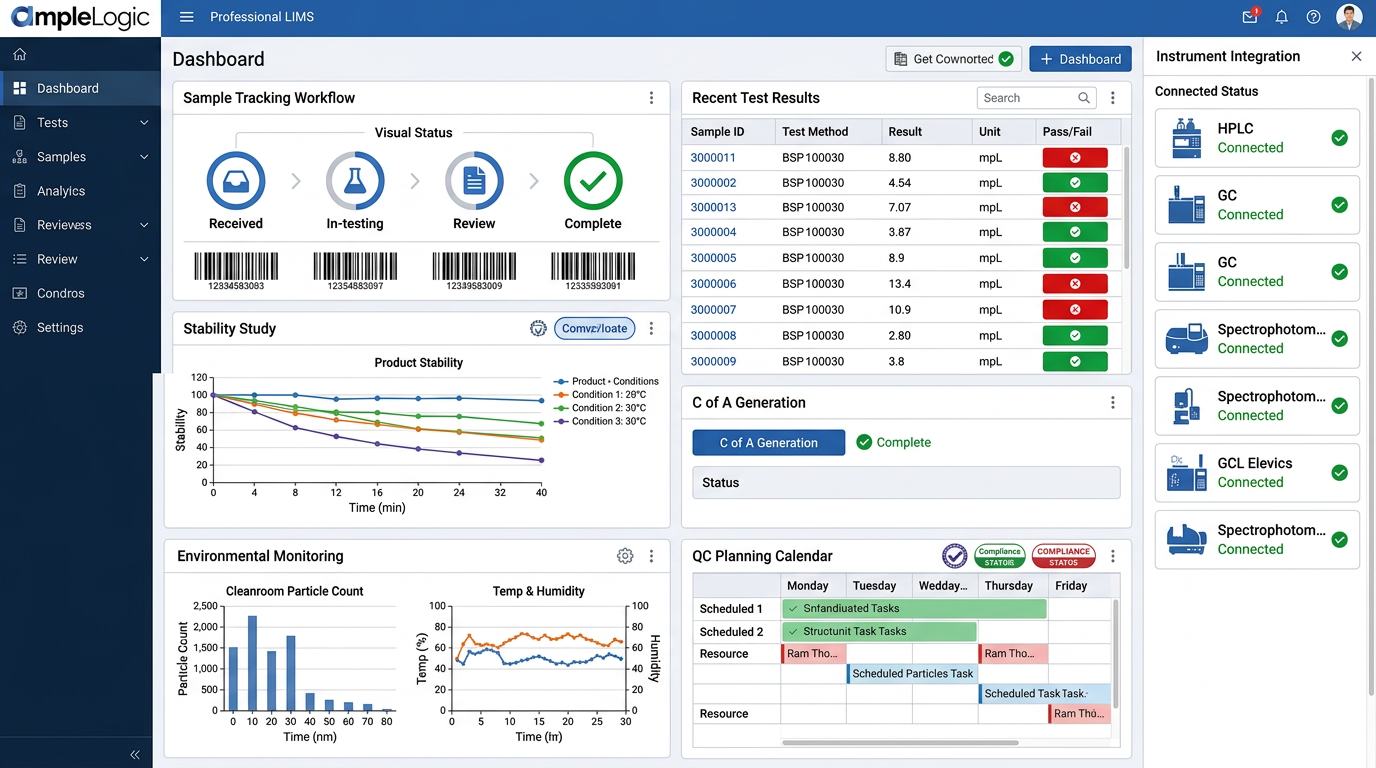
LIMS Connected Laboratory Ecosystem: Unified Digital Lab Platform
AmpleLogic LIMS — a cloud LIMS software, pharmaceutical laboratory informatics platform, and scientific data management system — creates a single source of truth for laboratory operations management, eliminating data silos, reducing transcription errors, and enabling real-time visibility across the enterprise.
Analytical Instruments
HPLC, GC, LC-MS, ICP-OES, UV-Vis, dissolution, and particle analyzers connected via validated bi-directional interfaces
ERP Systems
Seamless integration with SAP, Oracle, and NetSuite for batch release, inventory, and material management
Manufacturing Execution
Real-time data exchange with MES and eBMR for in-process testing, batch records, and production scheduling
Quality Management
Bi-directional integration with eQMS for deviation triggering, CAPA management, and OOS investigations
Chromatography Data Systems
Pre-built connectors for Empower, Chromeleon, OpenLab, and MassLynx with automated result import
Document Management
SOPs, analytical methods, and specifications synchronized with DMS for version-controlled lab operations
LIMS Purpose-Built for GxP Regulated Laboratories
Sample Registration
Automated sample login with barcode/RFID scanning, batch-level registration from ERP/MES, and configurable sample plans with pre-defined test assignments
Sample Tracking
Real-time chain-of-custody with location tracking, storage management, hold/release status, and automated alerts for approaching SLA deadlines
Test Execution
Template-driven analytical method execution with instrument data capture, system suitability verification, and in-line calculations with configurable rounding rules
Result Validation
Automated OOS/OOT detection, rule-based pass/fail evaluation, multi-level review and approval workflows with electronic signatures
Certificate of Analysis
Auto-generated COA/ROA with configurable templates, batch-level aggregation, customer-specific formats, and digital distribution
Regulatory Reporting
Inspection-ready data exports, stability trending reports, statistical analysis packages, and regulatory submission-formatted outputs for FDA/EMA filings
Sample Registration
Automated sample login with barcode/RFID scanning, batch-level registration from ERP/MES, and configurable sample plans with pre-defined test assignments
Sample Tracking
Real-time chain-of-custody with location tracking, storage management, hold/release status, and automated alerts for approaching SLA deadlines
Test Execution
Template-driven analytical method execution with instrument data capture, system suitability verification, and in-line calculations with configurable rounding rules
Result Validation
Automated OOS/OOT detection, rule-based pass/fail evaluation, multi-level review and approval workflows with electronic signatures
Certificate of Analysis
Auto-generated COA/ROA with configurable templates, batch-level aggregation, customer-specific formats, and digital distribution
Regulatory Reporting
Inspection-ready data exports, stability trending reports, statistical analysis packages, and regulatory submission-formatted outputs for FDA/EMA filings
Current LIMS Landscape
Understanding the state of laboratory informatics software and LIMS platforms today
Most labs already have a LIMS
Widespread baseline system presence
Existing LIMS are heavily customized and hard to upgrade
Bespoke integrations create upgrade friction
High maintenance and validation cost
Ongoing spend for upkeep and regulatory revalidation
Multiple point solutions coexist
Fragmented toolset increases integration burden
Lab Director Priorities: Validation & Total Cost of Ownership
Reduce LIMS validation burden + Consolidate point solutions to lower long-term total cost of ownership (TCO)
Key Challenges with Existing LIMS
Fragmented workflows, manual processes, and compliance risks
Focused Mainly on Sample Tracking
Limits visibility beyond sample entry and exit
- Limits End-to-End Visibility
- Increases Manual Handoffs
- Raises Compliance Risk
- Leads to Slower Product Releases
Stability and EMS Handled Outside LIMS
Fragmented operations increase complexity and risk
- Creates Fragmented Operational Control
- Limits Scope Coverage
- Complicates Validation
- Drives Need to Evaluate Replacements
Spreadsheet Dependency
Manual processes undermine compliance and efficiency
- Causes Manual Status Updates
- Weakens Trending and Audit Trails
- Increases Error Rates
- Makes Leaders Reliant on Informal Reporting
Poor User Experience
Legacy systems slow adoption and workflows
- Reduces Adoption
- Slows Daily Workflows
- Drives Customization Challenges
- Highlights Need for Integration Improvements
Instrument Integration Challenges
Instrument Silos
HPLC, GC, LC-MS, Micro systems operate disconnected
Manual Data Transfer from CDS
Chromatography data systems require hand-entry steps
Data Integrity Risks
Audit trail gaps and potential compliance violations
Complex Validation Burden
Each connection requires extensive system suitability tests
Prioritize Validated Connectors
Pre-built, qualified instrument integrations reduce risk
Prioritize Audit Trail Support
Complete traceability from instrument to report
Prioritize Minimizing Manual Handoffs
Automate data capture to reduce errors and cycle time
Core LIMS Software Capabilities
Purpose-built pharmaceutical LIMS software features for modern laboratory operations management
Sample Lifecycle Management
Enterprise sample tracking software providing end-to-end sample lifecycle management from registration through analysis, reporting, and disposition
Test and Method Execution
Define and execute analytical procedures with full traceability
Instrument Connectivity
Instrument integration software for seamless connectivity with lab instruments, chromatography data systems, and LIMS ELN integration
Barcode and RFID Handling
Automated sample identification and lab inventory management tracking
Quality Control Workflows
Built-in QC checks, approvals, and compliance verification across the digital laboratory platform
Electronic Signatures and Audit Trails
FDA compliant laboratory software with complete 21 CFR Part 11, GxP compliant LIMS, and ISO 17025 compliant LIMS requirements
Customizable Reporting
Laboratory analytics platform with flexible COA, ROA, laboratory performance analytics, and regulatory-ready report generation
Intuitive Dashboards
Real-time laboratory operations management dashboards with KPIs, scientific data analytics, and laboratory performance analytics
Advanced LIMS Modules
Purpose-built solutions for specialized lab operations
Advanced Stability Management
ICH-compliant stability study management software for pharma and biotech
AmpleLogic Advanced Stability Management is a purpose-built stability testing management system for managing the complete stability study lifecycle — from stability protocol creation and sample pull scheduling through chamber storage management, test execution, stability trend analysis, and regulatory-ready reporting. This stability program management solution delivers ICH Q1A-compliant automation, AI-powered shelf-life determination, and expiry determination analytics.
Key Features
Stability Protocol Creation
Define ICH Q1A-compliant stability protocols with configurable study designs, storage conditions, acceptance criteria, and automated sampling schedules aligned to global regulatory requirements
Stability Sample Scheduling
Automated sample pull scheduling with calendar-based reminders, dynamic rescheduling, and full audit trails for timely, error-free stability testing
Stability Chamber and Environmental Monitoring
Monitor stability storage conditions such as temperature and humidity across stability chambers and warehouses. Tracks environmental conditions, triggers alerts for excursions, and links stability data with sample results
Test Execution & Data Capture
Execute analytical tests within the same LIMS workflow with direct instrument integration, in-line calculations, and full traceability from stability study to individual result
Stability Trend Analysis & Reporting
Automated statistical trend analysis with degradation curve fitting, control charts, and regulatory-ready stability reports for ICH submissions and FDA filings
AI-Powered Shelf-Life Determination
Machine learning-driven shelf-life projection with confidence intervals, product shelf-life evaluation, early expiry risk alerts, and accelerated stability prediction
Expiry Determination & Retest Date Management
Systematic expiry determination based on stability trend data, retest date calculation, and automated label claim support backed by statistical evidence
ICH Q1A Regulatory Compliance
Built-in alignment with ICH Q1A stability guidelines, ICH Q1B photostability, ICH Q1C new dosage forms, ICH Q1D bracketing and matrixing, ICH Q1E evaluation, and ICH Q5C quality of biotechnological products
FDA Stability Requirements Compliance
Pre-configured workflows meeting FDA stability requirements including 21 CFR Part 211.166, FDA guidance for stability testing, and FDA-ready submission report formats
GMP Stability Program Management
Comprehensive GMP stability programs with ongoing stability commitments, post-approval stability monitoring, annual stability assessment, and deviation tracking with CAPA integration
Stability Trend Analysis and Shelf-Life Prediction
AmpleLogic analyzes stability test results to identify product degradation trends and estimate product shelf life. This allows organizations to detect stability issues early, optimize product expiry dates, and maintain regulatory compliance
Key Benefits
Accelerate stability study execution with automated scheduling and protocol management
Reduce shelf-life determination time by 40% with AI-driven trend analysis
Ensure full regulatory compliance with ICH Q1A, FDA, and GMP-aligned workflows
Eliminate missed sample pulls with automated sample pull scheduling
Centralize chamber storage management with real-time environmental monitoring
AI-Powered LIMS Software Analytics
Transform your laboratory data management system into actionable scientific data analytics — predictive quality analytics, anomaly detection, and smart scheduling that differentiates AmpleLogic from legacy LIMS software
AI Reference Standard Catalog Verification for Pharma Labs
AI automatically verifies the reference standard catalog and compares it with currently used standards in the laboratory — identifying updated, expired, version-changed, and newly available standards to ensure regulatory compliance.
- Ensures correct reference standard usage
- Prevents outdated standard usage
- Automated catalog updates and version tracking
AI Laboratory Assistant (LIMS-MAN): Virtual LIMS Trainer
Intelligent virtual assistant integrated into the LIMS platform. Users interact with natural language queries like 'What is the status of batch B12345?' or 'Show assay results for Product X' — retrieving lab data instantly and acting as a virtual trainer for new users.
- Faster access to laboratory information
- Reduced training time for new users
- Simplified LIMS navigation and decision making
AI-Driven Automated Worksheet Preparation for QC Labs
AI analyzes STP (Standard Test Procedure) data — including test parameters, calculation formulas, required reagents, instrument details, and acceptance criteria — to dynamically generate ready-to-use digital worksheets for analysts.
- Automatic test worksheet generation from STP data
- Intelligent population of calculation fields
- Elimination of transcription errors
AI Resource Optimization Engine for Laboratory Operations
AI-powered resource optimizer analyzes historical testing data and predicts future laboratory requirements — estimating required reagents, reference standards, consumables, and instrument utilization time for upcoming batches.
- Accurate procurement planning and inventory management
- Reduced reagent shortages and waste
- Optimized instrument utilization and cost reduction
Automated AI Result Review & Trend Analysis (Virtual Reviewer)
AI-driven virtual reviewer continuously analyzes analytical data — detecting errors during analysis, reviewing audit trails automatically, identifying abnormal trends, data integrity issues, OOT results, and flagging deviations from method of analysis.
- Faster result review with AI-driven insights
- Early detection of quality issues and OOT trends
- Reduced manual review workload
AI-Based Chromatogram Evaluation for HPLC, GC & UPLC
AI evaluates chromatograms from HPLC, GC, and UPLC instruments — automatically assessing peak areas, retention times, peak symmetry, resolution, and standard deviations. Alerts analysts immediately when deviations from standard patterns are detected.
- Automated chromatographic data review
- Detection of abnormal peaks and integration issues
- In-process review automation for sample sets
AI-Driven Stability Prediction & Shelf-Life Forecasting
Machine learning algorithms analyze historical stability study data to predict future product behavior — estimating shelf-life, degradation trends, stability variation probabilities, and risk of specification failures.
- Early identification of potential stability issues
- Data-driven shelf-life predictions with confidence intervals
- Improved regulatory documentation for stability programs
AI Instrument Failure Prediction & Predictive Maintenance
AI continuously monitors instrument performance data — calibration records, usage hours, error logs, maintenance history, and performance trends — using predictive analytics to estimate failure risk levels and generate instrument risk scores.
- Predictive maintenance alerts before failures
- Reduced instrument downtime and delays
- Optimized maintenance scheduling
AI-Powered Sampling Time Estimation for Pharma QC
AI engine analyzes historical sampling data based on product type, material category, number of containers, batch size, and sampling procedure complexity to estimate expected sampling time for each batch.
- Improved laboratory scheduling and workforce planning
- Reduced sampling delays
- Increased operational efficiency
OCR-Enabled Document Processing for Laboratory Data
Optical Character Recognition (OCR) automatically extracts information from uploaded documents — including PDFs, images, scanned reports, certificates, and handwritten records — converting them into structured digital records integrated into the LIMS database.
- Automated data extraction from scanned documents
- Elimination of manual data entry
- Faster document processing and improved accessibility
AI Sample Testing TAT Prediction for Laboratory Efficiency
AI analyzes historical testing durations and predicts expected completion time for each sample — considering test method complexity, instrument availability, analyst workload, and historical test durations for accurate TAT forecasting.
- Accurate turnaround time forecasting
- Improved sample scheduling and prioritization
- Enhanced laboratory productivity
LIMS Workflow Architecture
End-to-end laboratory workflow automation from sample intake to regulatory reporting
Master Data
Products, Methods, Instruments, Users, Standards
Stability
Studies & Shelf-Life
Qualification
IQ/OQ/PQ Validation
COA/ROA
Regulatory
Master Data
- •Products
- •Methods
- •Instruments
- •Users
- •Quality Standards
Auxiliary Management
- •Asset Management
- •Chemical & Reagent Tracking
- •Column Management
- •Reference Standards
- •Solution Preparation
- •Media Management
- •Culture Management
Sample Lifecycle
- •Sample Registration
- •Collection & Receipt
- •Login to System
- •Assignment to Tests
- •Analysis Execution
- •Result Review & Approval
- •Certificate of Analysis (COA)
Regulatory Output
- •Certificate of Analysis (COA)
- •Report of Analysis (ROA)
- •Regulatory Submissions
Data Integrity & Compliance
Regulated pharma buyers demand ALCOA+ data integrity, 21 CFR Part 11, EU Annex 11, ISO 17025, and GxP compliance — all built into AmpleLogic enterprise LIMS platform
ALCOA+ Data Integrity Framework
Every data point is Attributable, Legible, Contemporaneous, Original, and Accurate — with Complete, Consistent, Enduring, and Available extensions built into the platform.
- Immutable audit trails for every data change
- Electronic signatures with intent and meaning
- Automated backup with data recovery validation
- Tamper-evident data storage architecture
FDA 21 CFR Part 11 Compliance
Pre-validated electronic records and signatures with closed-system controls, authority checks, and device verification for FDA-regulated laboratories.
- Configurable electronic signature workflows
- Authority checks and role-based access control
- Time-stamped, attributable audit records
- Closed-system security architecture
EU Annex 11 Compliance
Computerized system controls for European pharmaceutical manufacturing including validation requirements, data storage, printouts, and business continuity.
- Computerized system validation support (IQ/OQ/PQ)
- Data migration and archival controls
- Business continuity and disaster recovery
- Supplier qualification documentation
GxP Regulatory Compliance
Comprehensive Good Practice compliance across GLP, GMP, and GCP environments with built-in controls for ICH, WHO, PIC/S, and 16+ global health authorities.
- GLP, GMP, GCP workflow templates
- ICH Q2, Q7, Q10 guideline alignment
- Inspection-ready reporting packages
- Change control and revalidation support
Integrated Digital GxP Ecosystem for Pharma & Biotech Labs
One of AmpleLogic's biggest competitive advantages — our pharmaceutical laboratory informatics platform natively integrates with 13 GAMP solutions that competitors cannot provide
OOS results auto-trigger deviations; CAPA outcomes update test methods; change controls manage analytical procedure updates
Bi-directional: OOS → Deviations, CAPAs → Method Updates
Stability data and COAs feed directly into regulatory submissions; registration status updates sample testing requirements
LIMS → Stability Data → RIMS Submissions
In-process samples auto-created from batch records; QC results trigger batch release decisions; environmental data linked to batches
Bi-directional: Batch Samples ↔ QC Results
QC trending data, stability results, and OOS statistics auto-populate annual product review reports with zero manual compilation
LIMS → QC Trends + OOS Stats → APQR Reports
SOPs, analytical methods, and specifications version-controlled in DMS; effective documents auto-linked in LIMS test execution
DMS → Controlled Docs → LIMS Method Execution
Analyst qualifications verified before test execution; training completion auto-activates analytical method access
LMS → Training Status → LIMS Analyst Qualification
In-process and release testing data feed CPV statistical models for ongoing process capability monitoring
LIMS → Process Data → CPV Statistical Analysis
Cleanroom monitoring data linked to production batches; excursions trigger automated hold/release workflows in LIMS
EMS → Environmental Data → LIMS Batch Hold/Release
Unlike legacy enterprise, R&D-focused, or modular analytics LIMS vendors — AmpleLogic is the only vendor offering a complete, natively integrated GxP ecosystem where LIMS data flows seamlessly across quality, regulatory, manufacturing, and compliance systems without middleware or custom integration.
Enterprise LIMS Integration: ERP, ELN & Instrument Connectivity
Connect your enterprise LIMS platform to your entire operational ecosystem
Laboratory Instruments
Seamless connectivity with analytical equipment
- Mass Spectrometry (MS)
- HPLC
- GC
- ICP-OES
- UV-Vis
Enterprise Systems
Integration with business and manufacturing systems
- SAP
- Oracle
- NetSuite
- MES (Manufacturing Execution System)
- QMS (Quality Management System)
- DMS (Document Management System)
- ELN (Electronic Lab Notebook)
Data and Analytics
Connect to data warehouses and business intelligence
- Data Warehouses
- BI (Business Intelligence) Platforms
- AI/ML Engines
- Cloud Analytics
Connectivity Options
Multiple protocols for flexible integration
- 100+ Pre-built Connectors
- REST APIs
- SFTP
- Direct Database Connections
- HL7 (Healthcare protocols)
API-First Architecture
Modern, extensible platform for custom integration needs
- RESTful APIs
- Webhook Support
- Custom Connectors
- Third-party Integration Frameworks
Automated LIMS Compliance: Eliminate Repetitive Manual Checks
Automation-first platform reduces manual verification overhead
Automated Rule-Based Verifications
Eliminate manual QC checks with configurable business logic and compliance rules
Template-Driven Method Execution
Pre-configured templates ensure consistent execution and reduce manual configuration
Real-Time Instrument Qualification Status
Automatic tracking of system suitability and maintenance schedules
Master Data Harmonization
Single source of truth for standards, methods, and procedures across the lab
Exception-Driven Reviews
Focus analyst attention on deviations and out-of-spec results
End-to-End Process Flow
Automated routing of samples and results through complete laboratory workflow
LIMS Software ROI: Measurable Business Impact for Quality Labs
Real outcomes from LIMS transformation
+25%
Cycle Time Impact
-20%
Throughput Loss
+30%
Compliance Workload
20%
TAT Reduction
20% faster turnaround time for analytical results
25%
Productivity Increase
25% more samples processed per analyst shift
90%
Audit Readiness
90% reduction in time to close observations
The Hidden Cost of Legacy LIMS
Equipment Idle Time
Instruments sit unused between manual changeovers
10-30% capacity loss
Analyst Bottleneck
Manual verifications and approvals slow result delivery
Delays in sample turnaround
Data Silos Across Systems
ELN, MES, and CDS operate independently
Manual consolidation and error risk
Repetitive Manual Checks
Identical verifications performed at each step
+25% cycle time inflation
Validation and Change-Control Overhead
Extensive testing required for any system modifications
+30% compliance workload
How Intelligent Low-Code LIMS Outpaces Traditional Platforms
Side-by-side comparison of deployment approaches
| Dimension | Legacy Monolithic | Traditional Modular | Intelligent Low-Code |
|---|---|---|---|
| Implementation Timeline | 18-24 months | 12-18 months | 3-6 months |
| Total Cost of Ownership (TCO) | $2.5-3.5M | $1.8-2.5M | $1.0-1.5M |
| AI & Analytics | Legacy, limited to reporting | Add-on capabilities, additional cost | Embedded AI, native predictive analytics |
| Customization & Flexibility | Hard-coded, high change-control burden | Modular but requires developers | Low-code/No-code, business users can configure |
Implementation Timeline
Legacy: 18-24 months
Traditional: 12-18 months
Intelligent: 3-6 months
Total Cost of Ownership (TCO)
Legacy: $2.5-3.5M
Traditional: $1.8-2.5M
Intelligent: $1.0-1.5M
AI & Analytics
Legacy: Legacy, limited to reporting
Traditional: Add-on capabilities, additional cost
Intelligent: Embedded AI, native predictive analytics
Customization & Flexibility
Legacy: Hard-coded, high change-control burden
Traditional: Modular but requires developers
Intelligent: Low-code/No-code, business users can configure
AmpleLogic LIMS Market Positioning & Competitive Advantage
How AmpleLogic compares to established LIMS vendors
| Category | Vendors | Positioning | Limitation |
|---|---|---|---|
| Legacy Enterprise LIMS | Traditional Vendors | Highly configurable, established pharma customer base, broad instrument support | 18-24 month deployments, heavy customization required, high TCO, no integrated GxP ecosystem |
| Enterprise R&D Platforms | R&D-Focused Vendors | Molecular modeling + lab informatics, cloud platforms, AI/GenAI assistants | R&D focused not QC, expensive, vendor lock-in to closed ecosystems, limited manufacturing integration |
| Modern Digital Lab Platforms | Cloud-Native Startups | Cloud-native, modern UX, API-first, fast deployment for R&D | Limited pharma QC capabilities, weak regulatory compliance, not GMP-validated for manufacturing |
| Modular Analytics LIMS | Analytics-First Vendors | Built-in analytics/ML, cloud-native HTML5, integrated LIMS+ELN+LES+SDMS stack | Complex implementation, limited GxP ecosystem, AI features require validation overhead |
| Integrated GxP Platform | AmpleLogic | AI-driven lab informatics + complete digital GxP ecosystem (13 GAMP solutions), Low-Code/No-Code, 3-6 month deployment | Newer entrant building enterprise reference base |
Legacy Enterprise LIMS
Traditional VendorsPositioning: Highly configurable, established pharma customer base, broad instrument support
Limitation: 18-24 month deployments, heavy customization required, high TCO, no integrated GxP ecosystem
Enterprise R&D Platforms
R&D-Focused VendorsPositioning: Molecular modeling + lab informatics, cloud platforms, AI/GenAI assistants
Limitation: R&D focused not QC, expensive, vendor lock-in to closed ecosystems, limited manufacturing integration
Modern Digital Lab Platforms
Cloud-Native StartupsPositioning: Cloud-native, modern UX, API-first, fast deployment for R&D
Limitation: Limited pharma QC capabilities, weak regulatory compliance, not GMP-validated for manufacturing
Modular Analytics LIMS
Analytics-First VendorsPositioning: Built-in analytics/ML, cloud-native HTML5, integrated LIMS+ELN+LES+SDMS stack
Limitation: Complex implementation, limited GxP ecosystem, AI features require validation overhead
Integrated GxP Platform
AmpleLogicPositioning: AI-driven lab informatics + complete digital GxP ecosystem (13 GAMP solutions), Low-Code/No-Code, 3-6 month deployment
Limitation: Newer entrant building enterprise reference base
LIMS Software Analyst Recognition & Industry Awards
Trusted by leading organizations and recognized by analysts
Frost Radar - Leader Quadrant
Frost & Sullivan
Recognized as Leader in Low-Code LIMS space with 10x faster deployment
120+ Global Implementations
AmpleLogic
Proven track record with enterprise clients and Fortune 500 companies
2024-2025 Gartner Evaluation
Gartner
Included in Gartner Magic Quadrant for LIMS evaluation with third-party credibility
2024-2025
"Easy to use and user-friendly interface for lab management. Reduced manual work and helped us move toward completely paperless lab workflows."
Lab Manager
Pharmaceutical QC
"Good vendor support and responsiveness during implementation. The instrument integration capabilities streamlined our QC testing workflows significantly."
QC Analyst
Life Sciences
"The stability management and sample scheduling modules are exceptional. Real-time data visibility across all lab operations has been transformative for our team."
Verified G2 User
Laboratory Director
Stay Ahead in Life Sciences
Get the latest product updates, compliance news, and industry insights delivered to your inbox.